
I will return with my head held high: Sheikh Hasina
Gautam Lahiri, Millennium Post | ২০ মে, ২০২৬
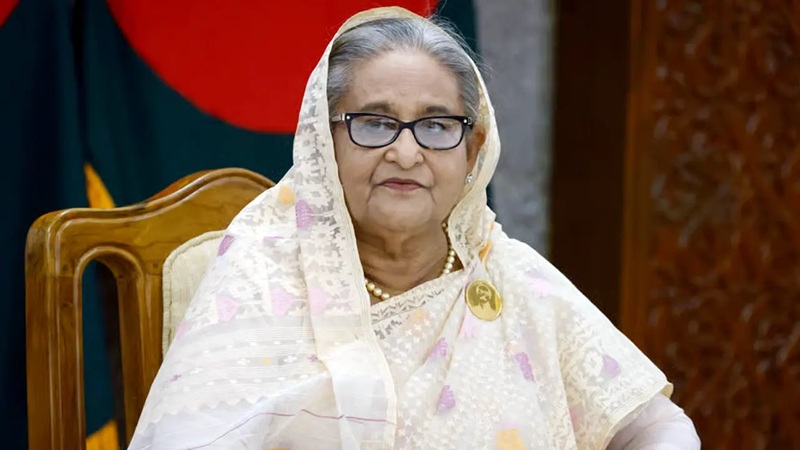
Former Bangladesh Prime Minister Sheikh Hasina has not ruled out her return to Dhaka, saying even in 1981 when she returned to her country on May 17 after six years of exile, there were conspiracies against her, threats to her life but she got on to complete the work of development of the country.
In this recorded telephonic conversation, she answers a wide range of questions on economic situation, relations with India, agenda of her Awami League party which is now banned by the government, threat of militancy and her mission of restoring democracy in Bangladesh.
Here are edited excerpts of her interview:
May 17 marks your Homecoming Day. Even if a return in 2026 is not possible, how realistic is a return in 2027?
Sheikh Hasina: May 17 is a deeply emotional and unforgettable day for me. After six years of exile, I returned to Bangladesh on this day in 1981. Even then, there were conspiracies against me. There were threats to my life. I returned home, ignoring every conspiracy and the threatening gaze of the rulers. Millions of people came down to the streets that day.
The question of return does not depend only on a fixed date. We are working to restore the democratic environment in Bangladesh, ensure freedom of expression, protect political rights, and bring back the rule of law. My absence does not mean my silence. We are active diplomatically, through international legal channels, and in the global media. I will return with my head held high, with the pride of restoring democracy in the country.
If there is a ban on the Awami League, how will your return be possible?
The love of the people is my greatest strength. All my life, I have worked for the welfare of the people of Bangladesh, whether in government or in opposition. The people of Bangladesh are still benefiting from the development carried out by the Awami League government.
In 1971, the then Pakistan government banned the Awami League. If bans could suppress the Awami League, Bangladesh itself would never have been born. This ban is a temporary display of force by those in power, but in reality, it reflects their fear. They are afraid of the Awami League because if the Awami League can carry out regular political activities, it will become difficult for them to continue their anti-state activities.
There is now discussion in different quarters about organizational purification within the Awami League.
The Awami League is a democratic party. Ideological workers are the lifeblood of this party, and they are the ones who determine its leadership. Whether you call it purification, reform, or renewal, it is a natural and regular process. This applies to every political party in the world.
At present, we are going through a natural process of purification. Those who are ideological leaders and workers are standing in their respective positions for the Awami League and for the country. Those who remain vocal for the Awami League despite all oppression and persecution are the true driving force of the party.
Will Awami League leaders who fled Bangladesh return home?
I disagree with the word “fled” because none of them left voluntarily. Since August 5, 2024, the state persecution that has descended upon Awami League leaders and activists is rare not only in the history of Bangladesh, but in world history. Nearly 600 of our leaders and activists have been brutally killed. Even elderly people and mentally unwell individuals were not spared from the killings. Around 1.5 lakh leaders and activists have been arrested in false cases at different levels. Their homes and business establishments have been vandalized, burned, and occupied. Thousands of leaders and activists are still in prison. Around 150 leaders and activists have been killed inside jail. Prisoners are not being given even minimum legal rights. The oppressive ruling group is not even allowing people to attend the funeral prayers of their loved ones.
Bangladesh is now facing a severe economic crisis. If you were in leadership, how would this crisis have been resolved?
This is a very important issue. The foundation of Awami League politics is the welfare of the people. We implemented mega projects such as the Padma Bridge, Metro rail, Rooppur Nuclear Power Plant, Matarbari Deep Sea Port, Karnaphuli Tunnel, and Bangabandhu Satellite. Bangladesh became known around the world as a role model of development and as the rising tiger of Asia. But after power was seized through a meticulous design, the interim government led by Dr. Yunus destroyed the country’s economy.
The country’s economy is now facing a frightening situation. There is crisis of electricity, oil, gas, fertilizer, and even irrigation. Now let me answer your question: I can say with certainty that if I had been in charge of the government, this situation would not have arisen in the first place. On the other hand, Yunus seized power for his own interest.
Children are dying in Bangladesh after being infected with measles. Why has the current government failed?
The death of every child breaks my heart. I am a mother. The most unfortunate thing is that these children are dying from a disease we had almost brought to the point of elimination. If everything had remained on track, we would have declared Bangladesh measles-free in 2026.
During my government, Through the EPI program, in coordination with UNICEF and GAVI, we conducted regular vaccination programs and brought infectious diseases among children almost to the point of elimination. Bangladesh’s vaccination program was a model for the world. In recognition of that, I received the GAVI Vaccine Hero award. During our time, maternal and child mortality rates were among the lowest in South Asia.
My question is this: even though there was sufficient allocation in the budget, why was the vaccination program disrupted? Why is there a shortage of medical supplies in hospitals? Where did the Tk 42,000 crore in the budget go?
What kind of steps is the Awami League taking for the release of jailed leaders, journalists, and intellectuals?
After August 5, 2024, the judiciary of the country has turned into a political weapon. Supreme Court judges were forced to resign through mob pressure.
People appointed to the Supreme Court and the High Court are those who implement a party agenda. Lawyers are being attacked when they stand in court for our leaders and activists. Even in the elections of the lawyers’ association, no one who believes in the ideals of the Liberation War was allowed to participate.
We are continuing the legal fight for the release of our leaders and activists at home and abroad. We are regularly sending reports and maintaining communication with the United Nations, the European Union, the Inter-Parliamentary Union, and various international organizations and human rights bodies.
How do you see the current government’s stance towards India and its growing closeness with China and Pakistan? Is militancy now being encouraged?
The foundation of our foreign policy is friendship to all, malice towards none. The purpose of this friendship is public welfare, and its foundation is fairness and equality. This principle is embedded in our Constitution. In our country, anti-India politics has always been one of the main weapons of anti-liberation groups who have no ideological foundation. It is one of the tools of their politics. That is why they constantly practice anti-India rhetoric for narrow political purposes.
Our political opponents have always accused the Awami League of selling the country to India or signing anti-state agreements. But during the eighteen months of the interim government and under the current government, they have not been able to produce even a single anti-state agreement. The people now understand this falsehood. When we came to power in 1996, we signed the Ganges Water Sharing Treaty. In 2014, through the settlement of maritime boundary disputes in an international court, we added nearly 20,000 square kms of maritime territory from India to Bangladesh’s map. In 2015, through the historic Land Boundary Agreement, we permanently resolved the enclave problem between the two countries. The India-Bangladesh Friendship Pipeline that we established is now working as one of the lifelines of Bangladesh’s energy sector during the global fuel crisis.
Are you seeking support from friendly countries and organizations around the world ?
I seek the cooperation of all democratic states and organizations in the world. What is happening in Bangladesh today is not merely an internal matter of one country. It is connected with fundamental human rights and democratic values. If democracy fails in Bangladesh, if a fundamentalist state is established, if the culture of lawlessness continues, then the 18 crore people of Bangladesh will suffer. Its impact will also fall on regional and global security
My message to the people of Bangladesh is: the Awami League will return, democracy will return. Every leader and activist of the Awami League will continue the struggle to build a democratic, inclusive, extremism-free, happy, and prosperous Bangladesh.
(This interview is based on a recorded telephone conversation of Sheikh Hasina with senior journalist and author Gautam Lahiri)
https://www.millenniumpost.in/world/us-iran-standoff-deepens-as-trump-halts-strikes-but-threatens-full-large-scale-assault-660574
✉ sylhettoday24@gmail.com ☎ ৮৮ ০১৭ ১৪৩৪ ৯৩৯৩
৭/ডি-১ (৭ম তলা), ব্লু ওয়াটার শপিং সিটি,
জিন্দাবাজার, সিলেট - ৩১০০, বাংলাদেশ।
Developed By - IT Lab Solutions Ltd.